What We Lost When Streaming Turned Up the Volume on Nature Docs
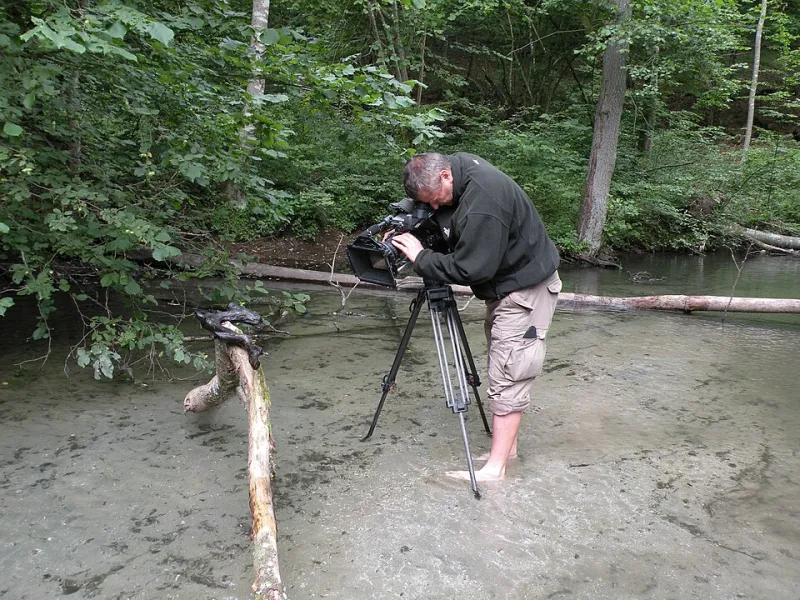
Photo: S.Czachorowski, CC BY-SA 3.0, via Wikimedia Commons
There's a scene burned into the memory of anyone who watched the original BBC Planet Earth in a darkened living room. A snow leopard descends a rocky slope in near-total silence. No narrator. No swelling orchestra. Just the faint crunch of paws on frozen ground and the whistle of high-altitude wind. You held your breath. The animal held yours.
Try finding that moment on a major streaming platform today. Go ahead. You've got maybe forty seconds before the autoplay countdown kicks in, a notification badge pulses in the corner of your screen, and the algorithm has already decided what you're watching next. The silence never stood a chance.
The Quiet Was Always the Point
It sounds almost too simple to say out loud, but the contemplative pause — the held breath, the long unbroken shot of an animal simply existing — was never filler in the great nature documentaries. It was the whole argument. Those moments asked viewers to slow down, to actually look, to feel the weight of a world that operates completely outside human schedules and human noise.
Filmmakers like David Attenborough and Cindy Bunn understood this intuitively. The silence wasn't absence. It was presence — a reminder that the natural world doesn't perform for us. We're the ones doing the watching.
But modern streaming infrastructure wasn't built around contemplation. It was built around retention metrics, completion rates, and the relentless fear of the back button. Silence, in that framework, reads as a problem to be solved.
How the Algorithm Killed the Pause
Here's what actually happens when a nature documentary hits a streaming platform in 2024. The content team reviews audience drop-off data. Anywhere viewership dips — even briefly — gets flagged. Editors are pressured to tighten cuts. Producers get notes asking for more narration, more music, more something to fill the gaps. The result is a documentary that never quite lets you breathe.
Autoplay is the other culprit nobody wants to talk about. Most major platforms default to rolling the next episode — or the next title entirely — within seconds of a credits sequence beginning. The contemplative exhale you might have taken after watching a humpback whale breach in slow motion? Gone. You're already three seconds into a cooking competition.
And then there's the sound design compromise. Nature docs mixed for theatrical or television broadcast were engineered for a specific acoustic environment. The quiet moments were calibrated. On a phone speaker, or even a mid-range soundbar, that calibration collapses. The silence that felt profound on a 65-inch screen with surround sound just feels like the audio dropped out on a laptop.
Filmmakers Who Are Pushing Back
Not everyone is giving in. There's a small but vocal contingent of documentary filmmakers who are treating intentional silence as a form of resistance — and some of them are finding audiences hungry for exactly that.
Independent productions, particularly those built around specific ecosystems or single-species subjects, have started using extended quiet sequences almost as a brand identity. The message is implicit: we trust you to sit with this. It's a direct counter-programming move against the dopamine-optimized scroll culture that dominates most of what people watch.
Some streaming platforms are starting to listen, too — at least at the margins. A handful of nature-focused channels and niche documentary services have quietly introduced "theater mode" features that disable autoplay and suppress notification overlays during playback. It's a small thing. But it signals an awareness that the viewing environment matters as much as the content itself.
Film festivals have become one of the last reliable homes for this approach. When a nature documentary screens at a festival, it gets the one thing streaming almost never provides: a room full of people who agreed, in advance, to pay attention. The silence lands differently when nobody's phone is buzzing on the armrest.
The Dialogue Problem
There's a subtler pressure worth naming, too. In the current streaming economy, nature documentaries are increasingly expected to carry a strong narrative voice throughout — partly because celebrity narrators are a marketing asset, and partly because platforms have data suggesting that voice-led content retains viewers longer than ambient or observational filmmaking.
The knock-on effect is a style of nature documentary that functions more like an audiobook than a film. The images become illustrations for the narration rather than the thing itself. You stop watching the animal and start listening to someone describe the animal. It's a meaningful difference, even if most viewers couldn't articulate exactly what shifted.
This isn't a knock on great narration — Attenborough's voice is, genuinely, one of the great instruments in documentary history. But his best work knew when to stop talking. The pauses were written into the script. That discipline is increasingly rare.
Why This Matters Beyond the Genre
You might be wondering why any of this is worth getting worked up about. It's wildlife TV. Does it really matter if the silence gets squeezed out?
Maybe more than it seems. Nature documentaries occupy a specific cultural role in the United States — they're one of the few remaining forms of mainstream media that routinely ask audiences to engage with the non-human world on its own terms. They're how a lot of kids first encounter ecosystems they'll never visit. They're how adults reconnect with something slower and older than the news cycle.
When those documentaries start optimizing for retention over revelation, something real gets lost. Not just aesthetically, but functionally. The whole point of watching a bird ride a thermal for forty uninterrupted seconds is that it changes your relationship to time, briefly. It reminds you that patience is a skill, and that the world rewards it.
Streaming platforms didn't set out to break that. They were just following the data. But the data doesn't measure what you carry with you after the screen goes dark.
Watching Differently
The good news — if there is good news — is that viewers have more control over their environment than the platforms want them to realize. Turning off autoplay takes thirty seconds in any settings menu. Watching on a proper screen with decent audio isn't a luxury, it's a choice. Seeking out independent or festival-circuit nature documentaries rather than defaulting to whatever the algorithm serves up is a habit anyone can build.
Some of the most compelling wildlife content being made right now exists specifically because its creators refused to chase the mainstream streaming formula. It's quieter, slower, and more willing to let a long shot breathe. You might have to look for it. But that's kind of the point.
The silence was always asking something of you. It still is.